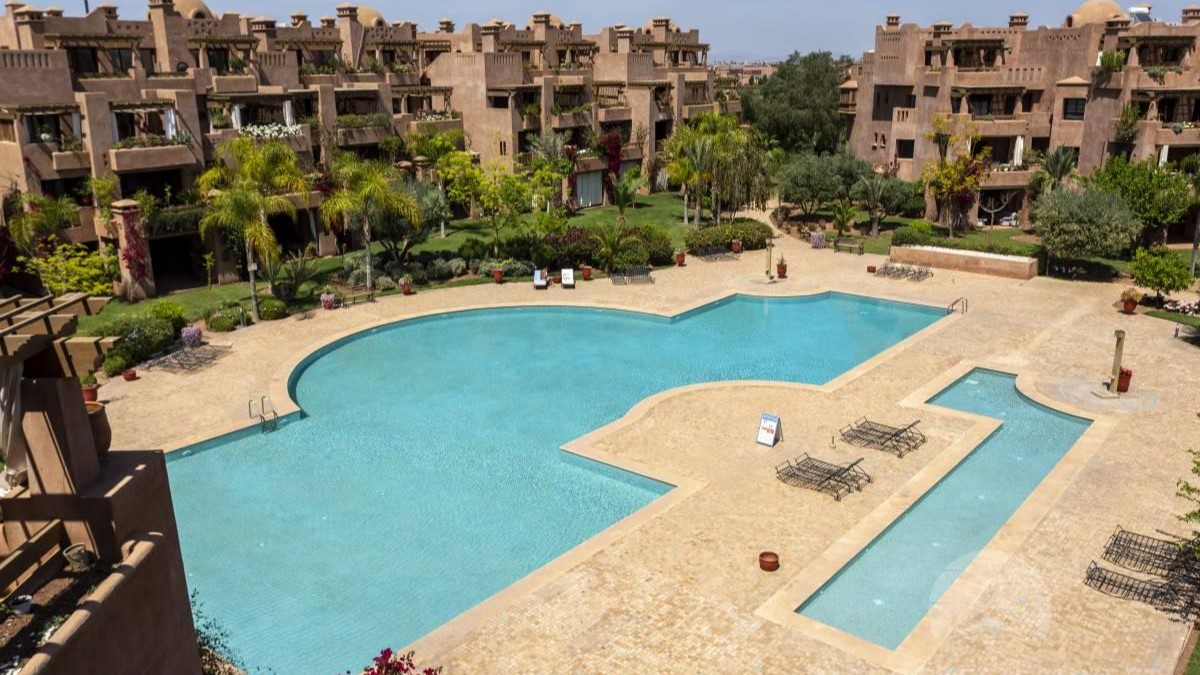
Retirement is the moment many people finally choose where they want to live, rather than where work tells them to live. For a growing number of Europeans, that place is Marrakech: three hundred days of sunshine, a three-hour flight from Paris or London, a cost of living well below most Western capitals and a city that combines the energy of the Medina with calm, green residential districts.
Choosing to retire in Marrakech is not only a lifestyle decision, though. It raises practical questions that a holiday never does. Where can you live legally for more than three months? How will your pension be taxed? What happens to your health cover? And above all, which home should you buy, where, and how do you avoid the mistakes that turn a dream into a burden ten years later?
This guide answers those questions step by step. It covers residency, pension taxation, healthcare, the best districts for retirees, how to compare an apartment, a villa and a riad, the real buying costs and the pitfalls we see most often. Whether you are looking at an Apartment for sale Marrakech in Guéliz or a single-storey villa with a garden, you will find the checks to make before you sign anything.
Why Marrakech is attracting retirees now
- More than 61,000 French retirees already live in Morocco (Bladi.net, February 2026).
- Foreign pensions permanently transferred to Morocco in non-convertible dirhams benefit from an 80% reduction of the tax due, on top of a 70% allowance on the first 168,000 MAD (Moroccan tax guide 2025).
- Foreign tourist arrivals in Morocco reached 19.8 million in 2025, compared with 12.9 million in 2019 (Ministry of Tourism, cited by Knight Frank).
- Menara airport's expansion is set to double its capacity to 16 million passengers, and high-speed rail should bring Casablanca within about 90 minutes (Knight Frank, 2026).
Foundations: What Retiring in Marrakech Really Involves
Before looking at property, it helps to understand the three pillars of a successful retirement abroad: the right to stay, the tax position and healthcare. Your choice of home depends on all three.
The right to stay: from tourist to resident
Citizens of France, the UK, Belgium, Spain, the US and many other countries can enter Morocco without a visa and stay up to 90 days at a time. Many retirees begin this way, spending the winter in Marrakech and the summer at home.
If you want to stay longer than 90 consecutive days, you need a residence card (carte de séjour). For retirees, the file typically includes:
- proof of a pension or regular income from abroad;
- proof of regular foreign-currency transfers to a Moroccan bank account;
- valid health insurance;
- a passport, photos and a Moroccan address, often a lease or a title deed.
The application is made in person at the police station (or the gendarmerie outside the city). According to OpenShores (2026), processing takes 4 to 12 weeks and can reach 2 to 3 months in Marrakech. The first cards are generally valid for one year and renewable. Foreign documents must be apostilled or legalised and translated into French or Arabic by a sworn translator.
Owning property does not give you automatic residency, but it makes your file stronger because it proves a stable address. Our article on the residence permit after buying property in Morocco covers this in more detail.
Tax residence: where will your pension be taxed?
Physical presence and tax residence are not the same thing. Under the France–Morocco tax treaty, pensions and life annuities are taxable only in the state where the beneficiary has their tax domicile (Article 17, as reported by Bladi.net in October 2026). Tax domicile is decided first by your permanent home, then by the centre of your economic interests, then by the time you spend in each country.
In practice, a retiree who sells their home in France, buys in Marrakech and spends most of the year there will usually become a Moroccan tax resident. A retiree who keeps their main home in Europe and spends winters in Marrakech usually remains taxable at home. Some public-sector pensions can follow specific rules, so always check your situation with your pension fund and a tax adviser before moving.
How Morocco taxes foreign pensions
Morocco offers one of the most favourable regimes in the Mediterranean for foreign pensions, provided you follow the rules precisely.
| Mechanism | What it means | Condition |
|---|---|---|
| Allowance (abattement) | 70% of the gross pension up to 168,000 MAD per year, 40% above | Applies to pensions declared in Morocco |
| Tax reduction | 80% of the tax due on the foreign pension | Pension transferred permanently to Morocco in non-convertible dirhams |
| Annual return | Global income declaration filed online on the SIMPL portal | Before 1 March of the following year |
| Supporting documents | Pension payment certificate + bank certificate showing the foreign-currency amount and its dirham equivalent | Attached to the return |
Sources: Moroccan tax guide 2025 as summarised by Bladi.net (July 2025); Bladi.net (October 2026).
To see what this means in practice, take a retiree receiving 240,000 MAD a year (roughly €22,000), entirely transferred in non-convertible dirhams. After the allowance (117,600 MAD on the first 168,000 and 28,800 MAD on the remaining 72,000), the taxable amount is about 93,600 MAD. On the 2025 income tax scale, the tax would be about 10,000 MAD, and the 80% reduction brings it down to roughly 2,000 MAD a year. This example is illustrative only; your adviser will confirm the exact figures for your situation.
Retiree tip
The 80% reduction depends on the transfer being made "permanently in non-convertible dirhams". Ask your Moroccan bank for the right account type and keep every annual bank certificate. Without them, you can lose the benefit, even if the money did arrive.
Healthcare: plan before you move
Healthcare is the question retirees most often underestimate. Marrakech has a university hospital (CHU Mohammed VI) and a large network of private clinics, specialists and dental practices, with prices generally lower than in Western Europe. But access to cover requires preparation.
For French retirees, rights under the France–Morocco social security agreement are opened with form SE 350-07. In April 2026, a French senator alerted the government that files could take six to eight months to process, leaving some retirees temporarily without cover (Alliance Solidaire des Français de l'Étranger, April 2026). Many retirees therefore take out private international health insurance or join the Caisse des Français de l'Étranger, at least during the transition.
Healthcare checklist before you buy
- Start your health cover paperwork several months before the move.
- Locate the nearest clinic, pharmacy and emergency service from each property you visit.
- Keep a paper and digital file with your medical history and prescriptions.
- Check that your insurance covers repatriation if you need it.
Daily life: climate, language and community
Marrakech has a semi-arid climate. Winters are mild and sunny, with cool nights, which is exactly why so many retirees spend October to April there. Summers are another story: from late June to early September, afternoon temperatures regularly pass 40°C. Some retirees love the heat; many prefer to travel in July and August and return in September. Your choice of home should reflect this rhythm.
French is widely spoken in administrations, banks, clinics and shops, and English is increasingly common in hotels, restaurants and agencies. Learning a few words of Darija, the Moroccan Arabic dialect, is appreciated and makes daily life warmer, particularly at the market and with neighbours.
The international community is large and active. Clubs, golf courses, associations, cultural centres, yoga studios and volunteer groups make it easy to build a social life. Many retirees tell us that their social life is richer in Marrakech than it was at home, provided they live close enough to the centre to take part.
Getting around is simple in the centre: taxis are inexpensive, and Guéliz and Hivernage are walkable. In the outer districts, a car or a regular driver becomes essential, which is worth considering when you choose where to buy.
| Season | Typical weather | What retirees usually do |
|---|---|---|
| October – November | Warm days, pleasant evenings | Return, enjoy terraces and golf |
| December – February | Mild sunny days, cold nights | Heating needed in the evening; festivals and family visits |
| March – May | Warm and bright | The most pleasant period of the year |
| June – September | Hot, often above 40°C in the afternoon | Many travel or live mainly indoors with air conditioning |
Current Trends and Key Statistics
Marrakech has long attracted retirees, but the profile and the market have changed significantly in recent years.
Who is retiring to Morocco
According to Bladi.net (February 2026), more than 61,000 French retirees live in Morocco, out of more than one million French pensioners living abroad. Agadir and the coast attract many of them, but Marrakech remains a favourite for those who prefer a city with culture, restaurants, golf and an international airport with direct flights to most of Europe.
Knight Frank (2026) notes that buyers in their 40s and 50s, often relocating with families or seeking a second base, now make up a larger share of demand, and that retirees, families and time-constrained buyers favour turnkey homes. That point matters: well-finished, ready-to-live-in properties are in short supply and sell quickly.
Prices: what your budget buys
Apartment prices vary widely by district. The ReaConsult 2026 barometer gives the following indicative ranges.
| District | Apartment price range (MAD/m²) | What retirees like |
|---|---|---|
| Hivernage | 12,700 – 19,100 | Central, quiet, close to hotels and restaurants |
| Avenue Mohammed VI | 12,000 – 18,000 | Modern residences, wide avenues, shopping |
| Guéliz | 9,900 – 15,300 | Walkable city life, cafés, clinics, shops |
| Medina / riads | 8,000 – 13,600 | Authentic charm, but stairs and narrow lanes |
| Palmeraie | 8,900 – 12,900 | Greenery, calm, gated residences |
| Targa / Route de l'Ourika | 8,000 – 12,000 | More space for the price, Atlas views |
Source: ReaConsult, Marrakech price barometer 2026, indicative data. A specific property can differ significantly from the range of its district.
For a 90 m² apartment in Guéliz, this suggests a budget of roughly 0.9 to 1.4 million MAD before buying costs. For more detail by area, see our guide to property prices per square metre in Marrakech.
At the top of the market, Knight Frank estimates that prime residential property typically trades between €5,500 and €7,000 per m², with prime values forecast to rise by around 6% in 2026.
Infrastructure that matters for retirees
Several projects linked to the 2030 FIFA World Cup are particularly useful for people who split their time between Marrakech and Europe:
- the expansion of Menara airport, planned to double capacity to 16 million passengers;
- the high-speed rail extension, expected to bring Casablanca within about 90 minutes;
- ongoing upgrades to roads, public spaces and health facilities.
For a retiree, a fast airport transfer and frequent flights are not a luxury: they make visits from children and grandchildren easier and simplify trips home for medical appointments.
Renting before buying
One of the clearest trends is caution. Knight Frank observes that many high-net-worth buyers now rent for six to twelve months before purchasing. For retirees, this is often the best advice of all: a full year lets you experience the summer heat, the winter evenings, the traffic and the real distance to the places you will use every day.
Practical Guide: Choosing and Buying Your Retirement Home
This section takes you from defining your needs to signing at the notary.
Step 1: Define how you will really live
Start with your daily life, not with the property. Ask yourself:
- Will you live in Marrakech all year, or six months a year?
- Do you want to walk to cafés and shops, or prefer a quiet garden away from the city?
- Will children and grandchildren come often, and for how long?
- Do you drive, and will you still want to drive in ten or fifteen years?
- Do you want to rent the property when you are away?
Your answers will point to a type of property and a district far more reliably than photos.
Step 2: Apartment, villa or riad?
| Criterion | Apartment | Villa | Riad |
|---|---|---|---|
| Accessibility | Excellent with a lift | Good if single-storey | Often difficult: stairs, terraces |
| Security | Gated residence, caretaker | Depends on the estate | Good, but the Medina can be busy |
| Maintenance | Low; shared via service charges | High: garden, pool, staff | High: traditional materials |
| Running costs | Moderate | High | Moderate to high |
| Access to services | Excellent in Guéliz and Hivernage | Car needed in most areas | Walking, but no car access |
| Renting when away | Easy, long or short term | Strong demand from families | Strong tourist demand |
| Best for | Year-round living, simplicity | Space, family visits, garden | Lovers of authenticity, active retirees |
For most people who retire full time, an apartment in a well-managed residence is the most practical choice. A villa makes sense if you want a garden and space for visiting family, and if you budget for staff and maintenance. A riad is a wonderful home for active retirees who love the Medina, but stairs, humidity and access for deliveries and ambulances need serious thought.
Think about the next 15 years
The home that suits you at 62 may be difficult at 78. Prefer a property with a lift or a ground-floor bedroom, wide doors, a walk-in shower and easy access by car. These features also make resale easier.
Step 3: Choose the right district
| District | Strengths for retirees | Points to check |
|---|---|---|
| Guéliz | Shops, clinics, pharmacies, cafés within walking distance | Traffic noise on main avenues, parking |
| Hivernage | Calm, green, central, upmarket | Higher prices, smaller supply |
| Agdal / Avenue Mohammed VI | Modern residences with pools and security | Car often needed |
| Golf resorts (Amelkis, Palmeraie, Route d'Amizmiz) | Gated communities, sport, social life | Service charges, distance from the centre |
| Palmeraie | Greenery and calm, large plots | Isolation, need for a car and staff |
| Route de l'Ourika | Space, mountain views, newer builds | 15–30 minutes from clinics and shops |
Many retirees find the right balance in Guéliz or Hivernage for daily life, or in a gated golf community if they want a pool and a social life without managing a large house. Our article on the best neighbourhoods to buy property in Marrakech compares the districts in more depth.
Step 4: The checks that matter for an apartment
When you visit an Apartment for sale Marrakech, look beyond the decoration:
- Lift and access. Is there a lift, does it work, and is it maintained under contract? Is there step-free access from the car park?
- Orientation and heat. Summer temperatures often exceed 40°C. A north- or east-facing living room, good insulation and efficient air conditioning make a real difference.
- Noise. Visit in the evening and at the weekend. Bars, mosques, building sites and main roads all sound different at night.
- The residence's management. Ask for the last general meeting minutes, the service charge budget and the reserve fund. Poorly managed residences age quickly.
- Parking and security. A secure parking space and a 24-hour caretaker are valuable when you travel.
- Paperwork. The apartment must have its own title (titre foncier) and, for recent buildings, a permis d'habiter.
Step 5: Budget the full cost
A clear budget avoids unpleasant surprises. Typical buying costs are as follows.
| Cost | Typical amount | Notes |
|---|---|---|
| Registration duties | 4% of the price (built property) | Collected by the notary |
| Land registry (ANCFCC) | 1.5% + 100 MAD | Registration of your title |
| Notary fees | About 0.5% to 1.5% + VAT | Depends on the price and the notary |
| Agency fees | Usually 2.5% to 5% + VAT | Agree in writing who pays |
| Bank and translation costs | Variable | Transfers, sworn translations, power of attorney |
For the detail, see our guide to notary and registration fees in Morocco. Knight Frank estimates total transaction costs for international buyers at around 10%.
Then plan the yearly costs: service charges, local taxes, electricity (air conditioning in summer is significant), water, internet, insurance and, for a villa, gardener, pool maintenance and possibly a housekeeper. Knight Frank estimates annual municipal taxes for a prime villa at around €3,000 on average; an apartment usually costs far less.
A realistic monthly budget for a retired couple
Costs depend heavily on lifestyle and on the type of home. The table below gives orders of magnitude for a couple living in a two-bedroom apartment in Guéliz, compared with a villa with a pool in a gated estate. These are estimates to help you plan, not quotes.
| Monthly item | Apartment in Guéliz | Villa with pool |
|---|---|---|
| Service charges / estate fees | 800 – 2,000 MAD | 1,500 – 4,000 MAD |
| Electricity, water, gas | 800 – 2,500 MAD (more in summer) | 2,500 – 6,000 MAD (pool, AC) |
| Internet and phone | 300 – 600 MAD | 300 – 600 MAD |
| Housekeeping | Optional, 1,500 – 3,000 MAD | 3,000 – 6,000 MAD |
| Gardener and pool maintenance | – | 2,000 – 4,000 MAD |
| Groceries and markets | 4,000 – 7,000 MAD | 4,000 – 7,000 MAD |
| Health insurance | Depends on age and cover | Depends on age and cover |
| Transport | Taxis, about 500 – 1,000 MAD | Car or driver, 1,500 – 4,000 MAD |
The difference between the two columns is often 8,000 to 15,000 MAD a month. Over a 15-year retirement, it is worth weighing carefully against the pleasure of a garden and a pool. If you do prefer a Villa for sale Marrakech, a single-storey home on a reasonable plot in a managed estate keeps these costs under control.
Step 6: Bring your money the right way
How you pay is as important as what you buy:
- pay through a Moroccan bank account in your name, funded by transfers from abroad;
- keep every transfer certificate: they prove the foreign origin of the funds and allow you, or your heirs, to repatriate the money after a sale;
- never pay in cash. Since the 2026 Finance Act, an additional 2% registration duty applies when more than 300,000 MAD is paid in a non-traceable way.
Our article on repatriating money after selling property in Morocco explains why this matters for the future.
Step 7: Follow a secure buying process
- Define your budget, district and type of property.
- Rent for a few months if you can, to test the area in different seasons.
- Visit with an agency that knows the residences and their management.
- Ask the notary for a recent title certificate showing owners, mortgages and charges.
- Check the permis d'habiter, the service charges and any building works planned.
- Sign the preliminary agreement before the notary, by authentic deed, as required by law 41.25 since 16 July 2026.
- Pay the deposit through the notary's escrow account.
- Transfer the balance and sign the final deed before the notary.
- The notary registers the sale and your title is updated at the land registry.
- Transfer utilities, insurance and service charges into your name.
Step 8: Renting your home when you are away
Many retirees spend part of the year elsewhere. Renting your property during those months can cover service charges and local taxes, or more. Knight Frank reports that short-term rental gross yields of 7% to 10% are now achievable in Marrakech for the right properties, although net returns are lower after management, cleaning, wear and tax.
If you rent, declare the income, follow the rules for tourist rentals and use a professional manager for check-ins and maintenance. Our article on Airbnb tax in Marrakech explains what you will pay. Seen this way, your home becomes both a place to live and a modest Real estate investment Marrakech that protects your capital.
Pitfalls to Avoid and Best Practices
Pitfall 1: Buying on the strength of a holiday
A January week in the sun is not a July afternoon at 44°C. Visit in several seasons or rent first. Many retirees who rushed into a remote villa later moved to a central apartment.
Pitfall 2: Choosing a home that will not suit you in ten years
Stairs, a long drive to the nearest pharmacy and a large garden to manage are charming at first and tiring later. Think about accessibility, proximity to services and the possibility of help at home.
Pitfall 3: Forgetting the health cover gap
The paperwork for health cover can take months. Keep private insurance until your rights are confirmed, and keep a reserve for medical costs.
Pitfall 4: Losing the pension tax benefit
The 80% tax reduction requires a permanent transfer in non-convertible dirhams, an annual return and the right bank certificates. A pension paid into a European account and spent by card in Morocco does not qualify.
Pitfall 5: Paying in cash or under-declaring
It is still sometimes suggested to declare a lower price and pay the difference in cash. Refuse: it exposes you to tax penalties, the extra 2% duty, and makes it impossible to repatriate the undeclared amount when you sell.
Pitfall 6: Ignoring succession planning
What happens to your Moroccan property when you die depends on your nationality, your religion and the rules of private international law. Ask your notary which inheritance rules apply, whether a will is advisable and how your heirs will be able to sell and repatriate the proceeds. Planning this early saves your family time, money and stress.
Best practices in one place
- Rent before you buy, ideally through a summer.
- Prefer accessibility and proximity to services over size.
- Use a notary for every step and pay only through banks.
- Set up your tax and health cover before the move.
- Plan your succession with a notary from the start.
Case Studies: Retirement Projects in Marrakech
The following examples are illustrative and based on situations we frequently encounter.
Case 1: The couple who swapped a villa project for a Guéliz apartment
A couple from Lyon had planned to buy a villa on the Route de l'Ourika. After renting there for one winter, they realised that every trip to the doctor or the market meant 25 minutes by car. They bought a 110 m² apartment with a lift and a terrace in Guéliz, close to clinics and cafés. They now walk everywhere and use the savings to travel.
Lesson: test daily life before you choose a location.
Case 2: The widower who chose a golf residence
A retired engineer from Brussels wanted security and a social life. He chose a two-bedroom apartment in a gated golf community with a pool, a restaurant and a 24-hour caretaker. When he returns to Belgium for the summer, the residence's rental service rents it out.
Lesson: a well-managed residence can provide security, community and income.
Case 3: The retirees who kept their pension tax benefit
A retired couple from Bordeaux became Moroccan tax residents and transferred their pensions monthly into a non-convertible dirham account. Each year they file their return with the bank certificates. Their pension tax is a fraction of what they paid in France.
Lesson: the tax benefit is real but administrative. Organise the bank side from day one.
Case 4: The family villa planned for three generations
A couple from London bought a single-storey villa with four en-suite bedrooms in a gated estate near the Palmeraie, so that children and grandchildren could visit at the same time. They hired a part-time housekeeper and a gardener, and rent the villa out in July and August when they travel.
Lesson: a villa works for retirement when it is designed for accessibility and budgeted with staff and maintenance.
The Next Wave: How Retirement in Marrakech Is Evolving
More senior-friendly residences
Developers are adapting their projects to older buyers: lifts in small buildings, ground-floor units with gardens, concierge services and on-site management. We expect more residences designed explicitly for active retirees.
Better connections with Europe
The airport expansion and high-speed rail will make Marrakech even easier to reach. For retirees who split their year, this strengthens the case for a lock-up-and-leave apartment with a professional rental service.
More formal transactions
Law 41.25, in force since July 2026, requires authentic deeds for transfers and promises of sale. Combined with the push for traceable payments, this makes transactions more secure for foreign buyers.
Healthcare provision
The growth of private clinics and specialised medical services in Marrakech continues. At the same time, the administrative difficulties around health cover for French retirees are a political subject, and procedures may become simpler if the digitisation requested in 2026 goes ahead.
A premium on turnkey quality
As Knight Frank notes, retirees and families favour turnkey homes, and quality stock is limited. Well-designed, well-located and well-managed properties should continue to hold their value best.
Your Retirement Home Checklist
Before you travel
- Calculate your net monthly income after tax in Morocco.
- Decide between full-time and part-time residence.
- Start the health cover paperwork.
- Set a total budget including buying costs and a reserve.
During your visits
- Visit at different times of day and, if possible, in summer.
- Time the journey to the nearest clinic, pharmacy and supermarket.
- Check the lift, the stairs, the bathroom and the parking.
- Ask for service charges and recent general meeting minutes.
Before you sign
- Obtain a recent title certificate through your notary.
- Check the permis d'habiter and any planned works.
- Make sure every payment goes through the notary and the bank.
- Ask about inheritance rules and whether to write a will.
After the purchase
- Register utilities, insurance and service charges in your name.
- Apply for the residence card if you stay more than 90 days.
- Set up the pension transfer and keep every bank certificate.
- File your first tax return before 1 March.
Frequently Asked Questions
Can a foreign retiree buy property in Marrakech?
Yes. Foreigners can buy apartments, villas and riads in their own name. The main restriction concerns agricultural land outside urban areas. Every purchase goes through a Moroccan notary.
Do I need a residence card to live in Marrakech?
Only if you stay more than 90 consecutive days. Many retirees spend the winter in Marrakech without a card; those who live there full time apply for a residence card at the police station.
Does buying a property give me residency in Morocco?
Not automatically. Owning a home strengthens your application because it proves a stable address, but you still need to meet the income and insurance conditions.
How is my pension taxed if I live in Marrakech?
If you become a Moroccan tax resident, your foreign pension is generally taxable in Morocco, with a 70% allowance up to 168,000 MAD and an 80% reduction of the tax due if it is permanently transferred in non-convertible dirhams. Check your situation with a tax adviser.
Is an apartment or a villa better for retirement?
For full-time living, an apartment with a lift in a well-managed residence is usually the simplest choice. A villa suits retirees who want space for family and a garden and who budget for staff and maintenance.
Which districts do retirees prefer?
Guéliz and Hivernage for their services and walkability, Agdal for modern residences, and the gated golf communities for security and social life.
Can I rent my home when I am away?
Yes, provided you declare the income and follow the rules for tourist rentals. A professional manager will handle bookings, check-ins and maintenance.
How much should I budget on top of the price?
Plan around 7% to 10% for buying costs, depending on agency fees, plus a reserve for furnishing, small works and the first year of running costs.
Is Marrakech too hot for retirees in summer?
Summers are hot, often above 40°C in the afternoon. Many retirees travel in July and August or live with good air conditioning and an orientation that limits sun exposure. Spring, autumn and winter are very pleasant.
Can I buy from abroad if I cannot travel for every step?
Yes. A notarised power of attorney, which must respect the legal form, allows a trusted person to sign on your behalf. Your agency can organise video visits and coordinate with the notary, and all payments go through the banks.
What happens to my property if I move back home later?
You can sell it or rent it out. If you financed the purchase with foreign currency transferred through the banks, and kept the certificates, you can repatriate the sale price, subject to the applicable taxes. This is why traceable payments matter from the start.
Is it better to buy new or resale?
New residences often offer lifts, modern insulation and pools, but check the developer's track record and the delivery date. Resale properties can be better located and ready to live in immediately. In both cases, the quality of management and the title are what count most.
Why choose Marrakech Sunset?
Marrakech Sunset helps retirees find an apartment, villa or riad that fits their real life, not just their holiday. We know the residences, their management and the districts, and we coordinate each step with your notary. Contact us to talk about your retirement project, with no obligation.