

Buying Titled Land in Marrakech: Key Steps to Secure Your Land Project
Marrakech, with its spectacular landscapes at the foot of the Atlas Mountains, attracts many investors each year who want to build their dream home or develop a major tourism project. Whether you are planning a contemporary designer villa or an exceptional estate, acquiring the right plot is the starting point of any real estate adventure.
However, purchasing land in Morocco obeys specific legal and administrative rules. To ensure your dream does not turn into an administrative obstacle course, securing your transaction must be your absolute priority. This guide details the key steps to invest with complete peace of mind.
1. Why You Must Absolutely Require Titled Land in Marrakech
In the Moroccan real estate landscape, not all plots share the same legal status. A major distinction is made between titled properties (registered with the Land Registry, or Conservation Foncière) and untitled properties (often under the traditional customary status known as Melk).
To secure your investment, buying titled land in marrakech is a non-negotiable condition:
-
Guaranteed Ownership: The land title (the equivalent of a property deed registered in the land registry) is established by the Land Registry Administration. It is definitive, unassailable, and clears any undisclosed prior claims.
-
Precise Boundaries: Every titled plot has an official cadastral map drawn up by a licensed topographer, defining its exact geographic boundaries to the nearest centimeter.
-
No Ownership Disputes: Purchasing a titled land in marrakech protects you against ownership claims from third parties (which are common on family-owned joint properties under Melk status).
2. Comparative Table: Titled Land vs. Melk Land (Untitled)
To help you understand the legal stakes when browsing listings for land for sale in marrakech, here is a brief comparative overview:
|
Comparison Criteria |
Titled Land |
Melk Land (Untitled) |
|---|---|---|
|
Legal Security |
Maximum and guaranteed by the Moroccan State |
Low, high risk of family or boundary disputes |
|
Boundary Definition |
Official boundary markers and cadastral plan |
Boundaries often based on natural or oral landmarks |
|
Bank Financing |
Easily eligible for real estate loans |
Generally refused by banking institutions |
|
Ease of Resale |
Very smooth, fast, and transparent transactions |
Highly complex, requires a long registration process |
|
Building Permit |
Immediate after architectural project approval |
Impossible without starting a land titling process |
3. Essential Steps to Secure Your Land for Sale in Marrakech
Acquiring a plot of land for sale in marrakech requires a rigorous process of legal and technical due diligence.
Step 1: Analyzing the Title Deed with a Notary
As soon as a plot catches your eye, ask a notary to obtain a recent certificate of ownership (dating back less than $48\text{ hours}$) from the Land Registry. This document will confirm:
-
The actual identity of the owner(s).
-
The exact surface area registered.
-
The absence of any outstanding charges, mortgages, seizures, or judicial warnings on the plot.
Step 2: Obtaining the Urban Planning Information Note (NRU)
Issued by the Urban Agency of Marrakech, this official document is crucial. It details the zoning area of the land (villa zone, tourist zone, agricultural zone, etc.) as well as the building regulations that apply to it.
Step 3: Non-Agricultural Vocation (VNA) – For Foreign Investors
If you are a foreign national (whether an individual or a corporation) and wish to purchase land outside the urban perimeter (in a rural zone), Moroccan law requires you to obtain a Certificate of Non-Agricultural Vocation (AVNA).
-
This administrative document, issued by the Provincial Commission, authorizes the change of land use (from agricultural use to residential or tourist use).
-
The final purchase of rural land by a foreigner cannot be validated by the notary without this definitive AVNA.
4. Validating Feasibility: Finding the Right Building Land in Marrakech
While legal security is vital, ensuring that the ground can actually support your construction project is equally important. A viable building land in marrakech must be technically validated.
-
Soil Quality (Geotechnical Study): Marrakech features highly diverse soil types (expansive clays, silts, rocky areas). Before finalizing the purchase, it is highly recommended to perform a soil study through an approved laboratory to determine the type of foundations required and avoid unexpected structural costs later.
-
Utilities and Connections: Check the proximity and availability of drinking water, electricity (Medium or Low Voltage), and sewage networks. In rural areas (such as the Ourika Road or Fes Road), it is common to dig a well (requiring authorization from the Tensift Hydraulic Basin Agency) and install a septic tank compliant with environmental standards.
-
Local Building Regulations: Ensure you understand the Ground Coverage Ratio (CES) and the Floor Area Ratio (COS). For example, in rural villa zones, the maximum ground footprint is often limited to
$5\%$ to $10\%$of the total land area, with a maximum building height limited to a ground floor plus one upper floor ($R+1$), representing approximately$8\text{ meters}$in height.
5. How to Uncover the Best Land Investment Opportunities in Marrakech
The land market in the Red City is highly active, but the most beautiful plots are not always listed on public consumer portals.
To identify premium land investment opportunities in marrakech, focus your search on areas with high growth potential:
-
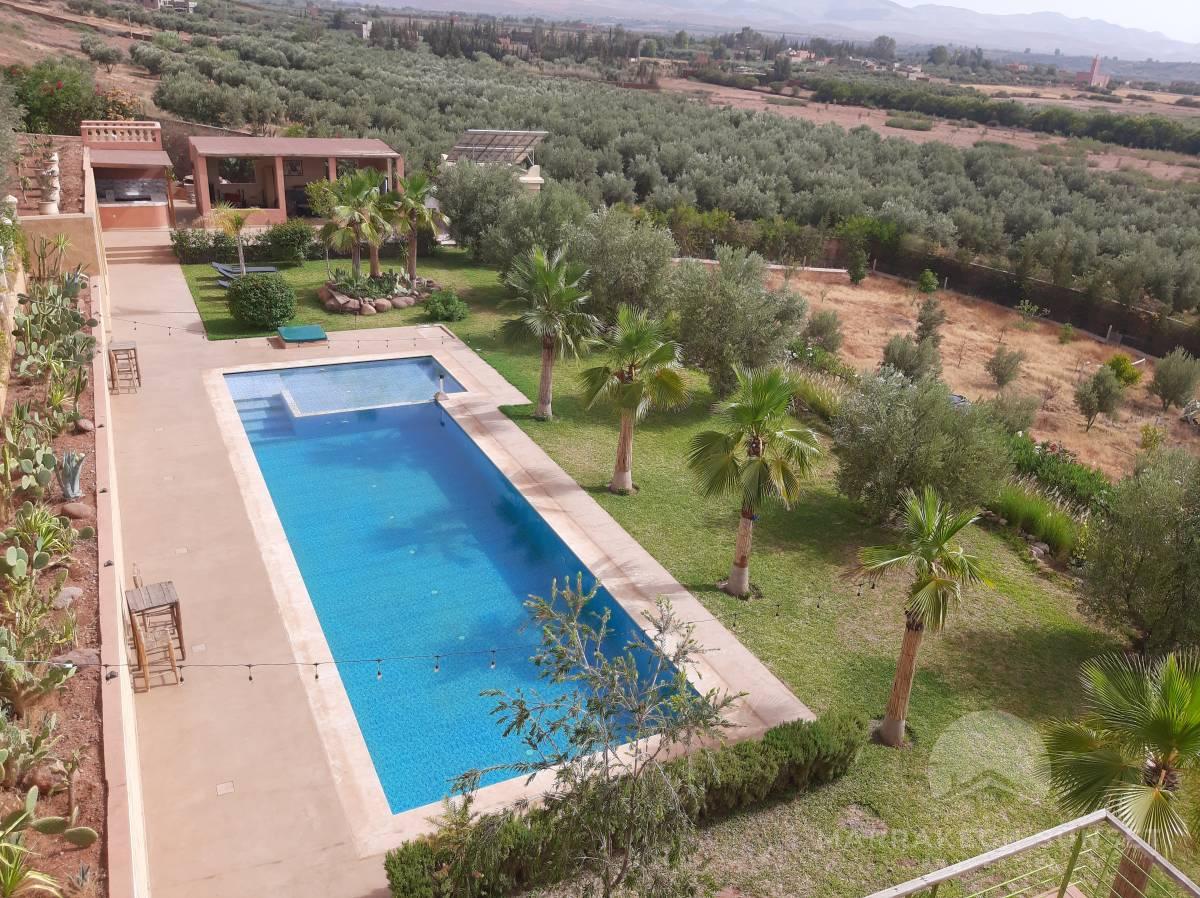
Amizmiz Road and Ourika Road: Highly sought after for building detached luxury villas with expansive landscaped gardens and panoramic views of the Atlas Mountains.
-
Bab Atlas and the Palmeraie: Highly exclusive sectors reserved for high-end estates, offering peace, privacy, and prestige just minutes from the city center.
-
Gated Residential Estates: Perfect for acquiring a pre-serviced plot of land within a secure private community with shared infrastructure (including
$24\text{/}7$security, maintenance, and golf course access).
To optimize your search and secure every technical and regulatory step, the support of local real estate professionals is indispensable. Specialized agencies have access to verified land listings and work closely with trusted notaries, topographers, and architects.
FAQ: Frequently Asked Questions About Buying Land in Marrakech
Can a foreigner buy any plot of land in Marrakech? A foreigner can freely purchase any plot located within urban zones (city limits). However, in rural zones, the acquisition is subject to obtaining a Certificate of Non-Agricultural Vocation (AVNA). Certain specific rural lands (such as collective tribal lands or strictly agricultural lands) cannot be purchased by non-Moroccans.
What additional fees should I expect when buying titled land? In addition to the purchase price of the land, you should budget approximately $7\%$ to $8\%$ for closing costs. This includes government registration duties ($4\%$), land registry fees ($1.5\%$), notary fees (typically between $1\%$ to $1.5\%$ depending on the transaction value), and topographer plan expenses.
How long does it take to get a building permit once the land is purchased? Once you own the titled land, designing the plans with your architect and submitting the application to the urban planning commission typically takes between $2\text{ to }4\text{ months}$. This duration depends on the complexity of your project and the zoning of the land.
Are you looking for the perfect plot to launch your building project in Marrakech? Contact our real estate experts today to access our exclusive portfolio of titled land and benefit from tailored guidance throughout your acquisition.