

Real Estate Valuation in the Palmeraie of Marrakech: Valuing and Selling at the Right Price
Real Estate Valuation in the Palmeraie of Marrakech: Valuing and Selling at the Right Price
The Palmeraie of Marrakech is not simply a prestigious address; it is a living legend, an oasis stretching over more than 13,000 hectares and home to hundreds of thousands of palm trees, where international high luxury meets the timeless charm of Morocco. Since the 1980s, this sector has established itself as the exclusive refuge of global wealth, artists, and investors seeking absolute privacy. However, conducting a Marrakech property valuation or assessing the true value of an estate in this ultra-exclusive enclave represents a complex challenge in 2026.
Unlike the dense urban neighborhoods of the Red City, the Palmeraie is characterized by an extreme heterogeneity of its properties. Two villas located only a few hundred meters apart can display value differences of several million dirhams. Land quality, legal land status, water resources, architectural signature, and administrative compliance are all variables that directly influence the valuation of an asset within the Marrakech prestige real estate market.
Whether you are an owner wishing to sell your asset under the best conditions or a buyer seeking to secure a strategic Marrakech real estate investment, this comprehensive guide written by our experts provides you with all the technical, methodological, and legal keys to master real estate valuation and successfully execute a villa sale Marrakech.
The Foundation: Property Types and Market Dynamics in the Palmeraie
To understand the value of a property in the Palmeraie of Marrakech, one must first grasp its underlying structure. This market does not follow the rules of classic real estate and requires a detailed analysis of every component of the asset. A villa purchase Palmeraie Marrakech represents a complex acquisition process where every detail, from the condition of the soil to the shading of the mature trees, carries a quantifiable cost and value.
The Micro-Geographical Segmentation: The Three Palmeraies
While it is common to speak of "the Palmeraie" in the singular, high-end real estate professionals distinguish three very specific micro-markets, each with its own pricing grid and level of exclusivity:
1. The Golden Triangle (The Historic Heart)
The oldest and most coveted sector, the Golden Triangle is the beating heart of the historic Palmeraie. Parrels here are vast (often exceeding one hectare) and the density of century-old palm trees is at its highest. This is the most sought-after sector, where supply is extremely rare and transaction prices reach record highs due to the lack of available land. To navigate this highly selective micro-zone, the guidance of an established Marrakech real estate agency is essential to access actual transaction history.
2. Bab Atlas and the Middle Atlas (Contemporary Elegance)
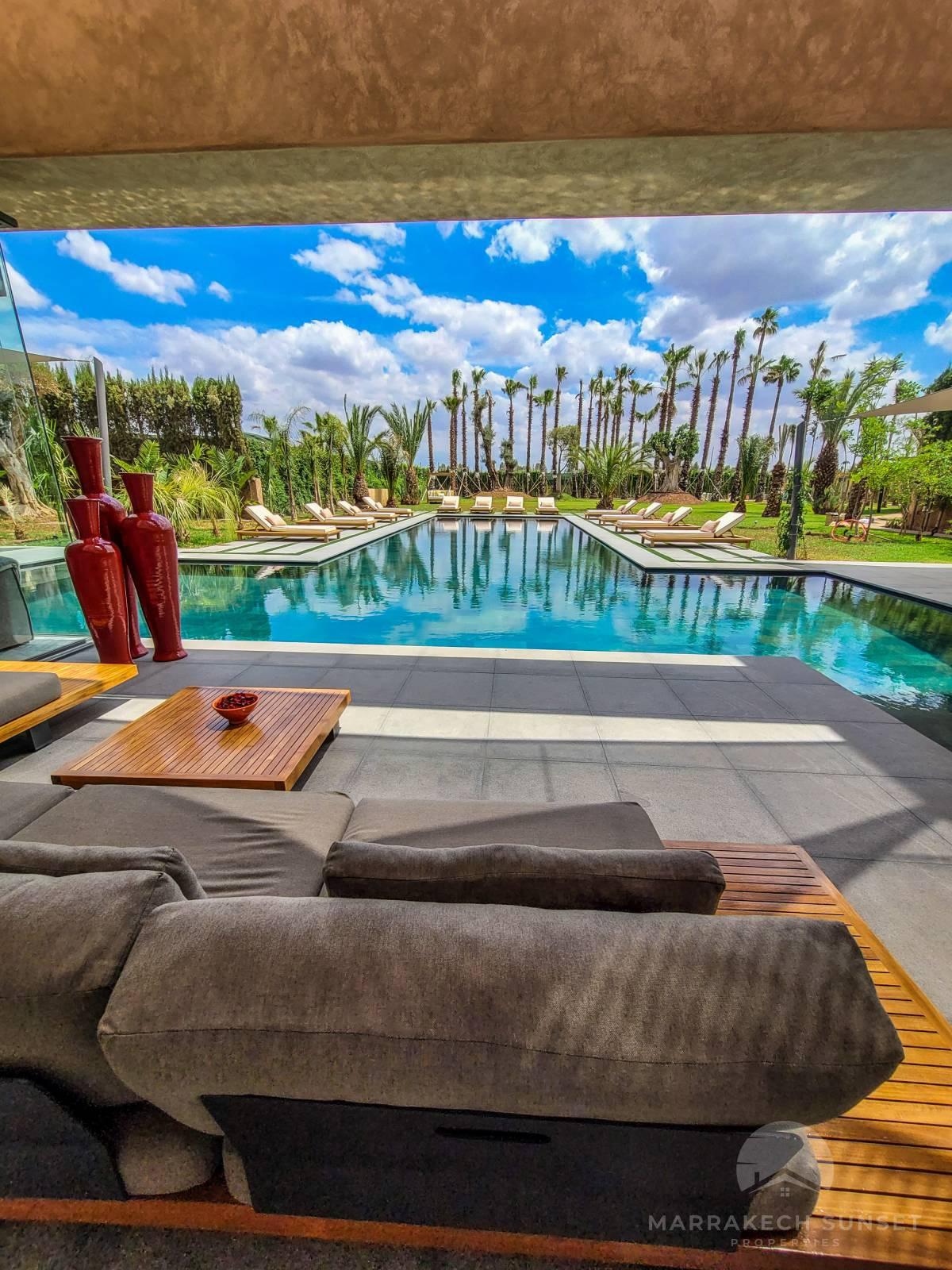
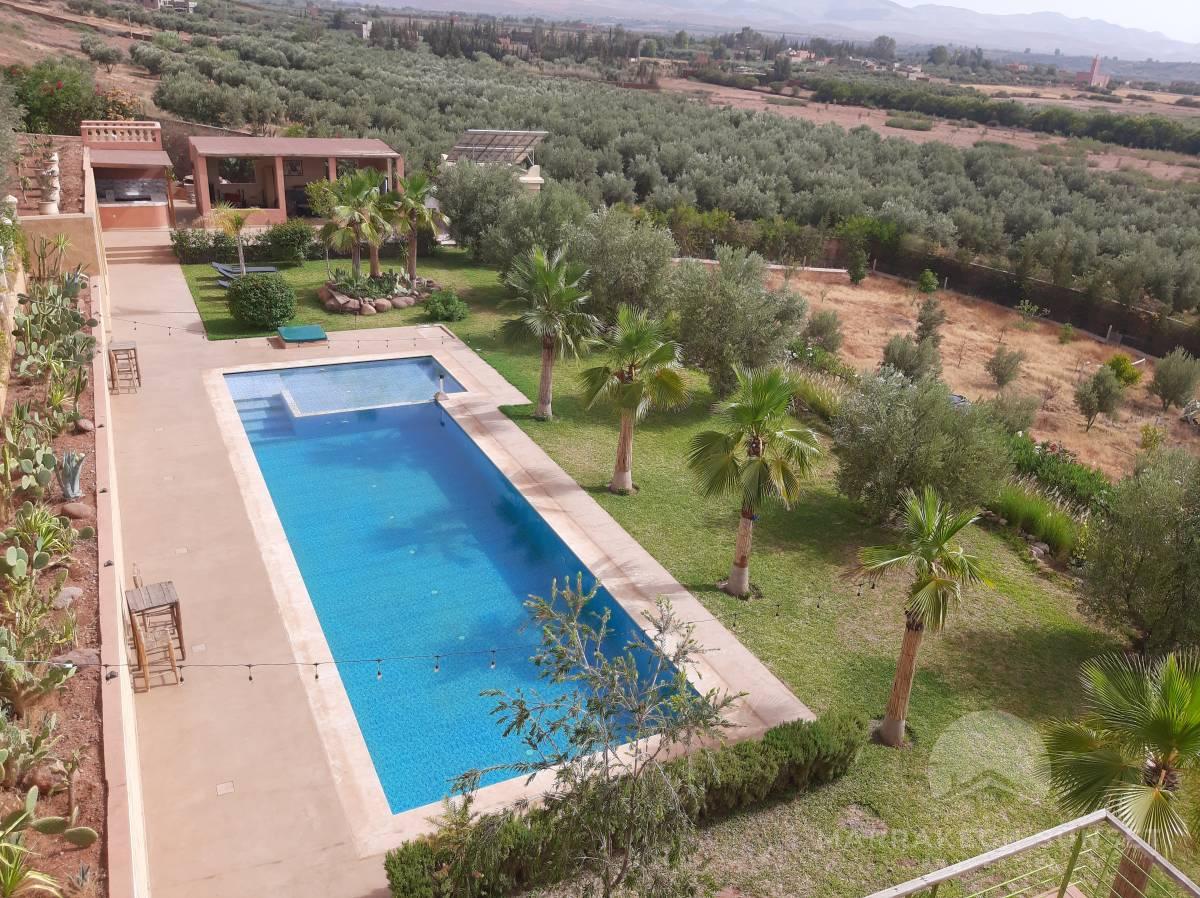
Located slightly further east, Bab Atlas has become the sanctuary of ultra-modern villas and contemporary architect-designed estates. While less dense in natural palm trees, it is richly planted with magnificent olive groves, offering superb visual perspectives of the Atlas Mountains. This is where transactions for newly built properties with sleek designs are concentrated, highly favored by international business clients. Here, experts closely analyze the price per sqm Palmeraie Marrakech for recent constructions combining state-of-the-art thermal insulation and monumental glass facades.
3. Peripheral Zones and Extensions (Ouidane and Route de Fès)
Moving east and north, we find recent extensions of the Palmeraie. These areas offer larger plots at more affordable land rates. Although the environment may be slightly less exclusive due to younger vegetation or closer proximity to major roadways, these sectors represent excellent opportunities for investors looking to maximize their built area while keeping the land price Palmeraie Marrakech under control.
Architectural and Property Typologies
The value of a property depends heavily on its architectural and functional classification. In the Palmeraie, three main families of luxury properties Marrakech coexist:
-
Sovereign Estates and Master Palaces: These are extraordinary properties, usually sitting on vast landscaped plots. They consist of a majestic main residence, complemented by several independent guest pavilions, staff quarters, mature wooded parks, and private wellness facilities. These exceptional properties are valued as a cohesive whole, combining the rarity of the wooded plot with the complexity of the buildings.
-
Private Villas in Gated Domains: These properties offer an excellent compromise between privacy and security. Located within high-end luxury co-ownerships, they benefit from round-the-clock security, maintenance of common areas, and concierge services. Their land plots are intermediate in size. They are highly sought after by secondary residents who do not wish to manage the heavy logistics of an isolated estate of several hectares.
-
Integrated Resort Properties and Golf Residences: Mainly consisting of front-line golf villas, penthouses, or luxury duplexes, these assets are part of world-class resorts offering immediate access to golf courses, clubhouses, restaurants, and luxury hotel spas. The value of these properties is strongly correlated with the services included in the co-ownership and the prestige of the resort itself, making them highly liquid assets for a future villa sale Marrakech.
Current Trends and Key Market Statistics in 2026
The real estate market in the Palmeraie has undergone major shifts over the past few years. The year 2026 is characterized by consolidation, marked by high buyer demand for sustainability, energy autonomy, and absolute legal transparency.
The Impact of the 2030 FIFA World Cup on the Palmeraie
The official announcement of Morocco co-hosting the 2030 FIFA World Cup has triggered an unprecedented wave of public investment in Marrakech. The Palmeraie benefits directly from this dynamic through:
-
Substantial Road Infrastructure Upgrades: Renovation of major access roads, creation of bypasses facilitating quick access to the international airport, and improvements to the internal road network of the Palmeraie.
-
Modernization of Public Utilities: Systematic deployment of high-speed fiber-optic networks and the renovation of ecological public lighting and water distribution networks.
-
Global Rise in International Stature: Marrakech is strengthening its status as a world luxury capital, attracting a new wave of international business owners and entrepreneurs looking to establish permanent or semi-permanent residences.
Market Price Statistics and Trends (2025/2026 Data)
Prices in the Palmeraie reflect the exceptional status of this enclave. There is a clear disconnect between properties requiring heavy renovation and "turnkey" estates built to modern ecological standards.
|
Property Category |
Average Price per Built sqm (MAD) |
Average Price of Raw Land (per sqm) |
Average Annual Net Rental Yield |
Average Time on Market (Liquidity) |
|---|---|---|---|---|
|
Exceptional Palace (Golden Triangle) |
35,000 to 60,000 |
1,800 to 2,800 |
4.5% to 5.5% |
12 to 18 months |
|
Contemporary Villa (Bab Atlas) |
30,000 to 45,000 |
1,200 to 1,800 |
6.0% to 7.5% |
6 to 9 months |
|
Villa in a Gated Domain |
25,000 to 35,000 |
1,000 to 1,500 |
5.5% to 6.5% |
4 to 8 months |
|
Golf Apartment / Penthouse |
22,000 to 30,000 |
N/A (Co-ownership) |
7.0% to 8.5% |
3 to 5 months |
Market Confidence Index (2026): Experts agree that the market for luxury properties Marrakech in the Palmeraie shows stable annual growth in the sustainable high-end segment. This trend is strongly supported by the complete lack of new constructible land in the historic heart of the Palmeraie, guaranteeing long-term capital appreciation for current buyers who secure a Marrakech real estate investment.
Practical Guide: Professional Valuation Methodology for Exceptional Properties
The financial evaluation of a villa or estate in the Palmeraie cannot rely on automated online estimates. The financial stakes require a structured approach, crossing several internationally recognized appraisal methods analyzed from a qualitative and factual standpoint by local experts.
The Three Major Valuation Approaches Explained
To appraise a high-end estate, professionals combine three fundamental methodologies to cross-reference data and eliminate valuation errors:
1. The Direct Market Comparison Method
This is the primary method. It consists of listing actual transactions recently completed on similar properties within a tight geographical radius. For this method to be effective, the appraiser adjusts the price of the reference properties by applying qualitative weightings to several key criteria. To obtain this first-hand information on actual sales (which are often kept confidential), working with an established Marrakech real estate agency is a decisive advantage.
-
Exact Location (Micro-localization): A property located in a quiet cul-de-sac in the Golden Triangle will command a premium compared to an estate bordering a busy thoroughfare.
-
Maturity of the Garden: Bare land or a plot with recent plantings does not hold the same value as a landscaped park filled with ancient olive trees and adult palm trees whose maintenance has been rigorously kept up for years. The value of a successfully transplanted adult palm tree can represent a highly significant sum.
-
Architectural Signature: Properties designed by renowned architects benefit from a significant brand premium upon resale compared to anonymous constructions.
2. The Depreciated Replacement Cost Method
Particularly recommended for unique properties or highly customized recent estates where direct comparison data is lacking, this method evaluates the overall value of a property by combining the current market value of the raw land with the current construction costs required to rebuild the structures identically.
The expert then applies a qualitative adjustment to account for the physical wear and tear of the villa and the structural quality of the materials. This process also highlights any technical obsolescence of the original installations or an outdated interior layout that no longer matches current luxury standards, requiring future adaptation.
3. The Rental Income Capitalization Method
More and more buyers of a prestige property in Marrakech view their purchase as a hybrid asset, combining personal use with high-end seasonal rentals during the rest of the year.
This method estimates the value of the estate by analyzing its capacity to generate steady revenue streams through exclusive holiday rentals. The appraiser deducts all operational expenses from the gross rental income, including security, pool and park maintenance, staff wages (housekeepers, chefs, managers), and management fees. This net recurring performance is then analyzed in relation to the average return expected by luxury real estate investors in this specific region.
Technical Valuation Criteria: Water and Energy Resilience
In the current climate context, the value of a property in the Palmeraie heavily depends on its technical resilience and autonomy. These are major checkpoints during an appraisal:
-
Water Autonomy: The presence of an authorized high-yield borehole (well), large-capacity storage tanks, and greywater recycling systems for garden irrigation.
-
Energy Autonomy: A modern solar photovoltaic panel installation with latest-generation inverters and battery storage systems, significantly reducing running costs.
-
Thermal Insulation: Insulated roofs, high-performance double glazing, and variable refrigerant flow (VRF) centralized air conditioning systems.
A property equipped with such modern green features will immediately secure a higher valuation from a luxury real estate agency Marrakech as it guarantees highly optimized monthly operational costs for the future owner.
Legal, Tax, and Administrative Specifics in Marrakech
Real estate valuation in the Palmeraie of Marrakech cannot overlook a thorough analysis of the property's administrative and legal standing. In Morocco, the legal security of a luxury transaction relies on precise documentation. The absence or non-conformity of these documents can slash the value of an estate by more than half of its theoretical price. A detailed review with a qualified Marrakech real estate notary is indispensable to validate the file before listing.
Land Status: Titled, Melkia, and Requisitions
It is imperative to ensure that the property has a definitive land title registered with the ANCFCC (National Agency for Land Conservation, Cadastre, and Cartography). A land title guarantees indisputable ownership and protects against any third-party claims.
-
Melkia Properties: These are properties governed by traditional law without a registered land title. In the Palmeraie, buying a Melkia property is extremely risky for international buyers and results in a heavy discount during valuation. Any transaction of this type requires a prior land titling process.
-
Immatriculation Requisitions: These are properties currently undergoing the titling process. Their value is intermediate, but the final transaction should ideally only be concluded once the definitive land title is issued.
The VNA (Vocation Non Agricole) Process for Foreigners
This is one of the most important legal points for international buyers. By default, many land plots in the Palmeraie of Marrakech hold agricultural status. Moroccan law prohibits foreign individuals or foreign companies from owning agricultural land unless they obtain a specific administrative authorization called the non-agricultural vocation Marrakech VNA.
There are two types of VNA:
-
Provisional VNA: Issued when the construction or tourism development project plans are submitted. It allows the works to begin.
-
Definite VNA: Issued once the construction is completed and certified compliant by an administrative commission. This is the document that allows the notary to transfer definitive ownership of the land title to a foreign buyer.
Golden Rule for Appraising a prestige property in Marrakech: A villa built in the Palmeraie that does not have a definite VNA, or for which obtaining the definite VNA is compromised, will see its pool of potential buyers restricted to Moroccan citizens or citizens of GCC countries. This automatically lowers its appraised value on the international market.
Property Taxation: Integrating Transaction Costs
Any financial valuation must integrate transaction costs and tax implications for both the seller and the buyer under current Moroccan property taxation rules:
-
For the Seller - Real Estate Profit Tax (TPI): This tax applies to the Morocco property capital gains realized upon resale. The tax is calculated on the net profit achieved, with a minimum tax floor based on the total sale price (even if a capital loss is declared). Total exemptions exist under specific conditions, notably for primary residences after several years of continuous occupation.
-
For the Buyer - Registration Fees and Conservation Taxes: In Marrakech, buyers must anticipate acquisition fees including registration duties, land conservation taxes, cadastral fees, and notary fees. These costs must be factored into the buyer's overall acquisition budget.
Pitfalls to Avoid and Best Practices for a Successful Appraisal
An incorrect valuation can have severe consequences. For the seller, an overpriced property sits on the market, loses its appeal, and eventually forces a sale at a price far below its true value. For the buyer, underestimating required works or ignoring legal issues can turn a dream project into a financial burden.
The Three Most Common Pitfalls in the Palmeraie
1. Relying Solely on Online Portal Asking Prices
There is often a massive gap between the asking prices of luxury villas on public websites and the actual transaction prices finalized at the notary's office. In the Palmeraie, negotiation margins on overpriced properties can be highly significant. Only a luxury real estate agency Marrakech with access to real, local transaction history can provide a realistic and accurate valuation.
2. Ignoring the True Cost of Energy and Technical Modernization
Many magnificent villas built in the 1990s or 2000s feature beautiful Arab-Andalusian architecture but suffer from outdated technical features: no thermal insulation, noisy and power-hungry air conditioning units, or failing roof waterproofing. Upgrading these elements to meet modern comfort and energy efficiency standards requires substantial capital. This cost must be factored in to adjust the final value of the estate.
3. Underestimating the Impact of Legal Defects on Negotiations
The absence of a habitation permit for extensions built without approval, boundary disputes with neighbors on large plots, or the lack of an official authorization for the water borehole are massive arguments used by savvy buyers to negotiate steep price reductions.
The Prestige Valuation Protocol
To avoid valuation errors, an appraisal should revolve around a triple professional audit:
-
A Complete Technical Audit: Evaluation of the building's structural integrity, thermal performance, and the compliance of water and air conditioning systems.
-
A Cadastral Verification: Hiring a licensed land surveyor to validate property boundaries, ensuring they match official cadastral maps and verifying the absence of neighbor encroachments.
-
A Legal Document Review: Detailed analysis of the property title, certificate of conformity, initial building permits, and the administrative status of the VNA.
The Crucial Role of Professional Assistance
Having your property appraised by recognized experts guarantees:
-
Valuation Neutrality: Owners often have an emotional connection to their property, which can cloud their judgment. An objective, professional eye brings factual and market-driven accuracy.
-
Access to Off-Market Data: The most exclusive transactions in the Palmeraie are often concluded confidentially ("Off-Market"). Only agencies connected to high-end networks possess these private transaction benchmarks.
-
Preparation of a Solid Sale File: Presenting a complete and professional valuation report reassures international buyers and private banks financing these transactions.
Case Studies: Real-World Transaction Analyses
Nothing is more valuable than analyzing actual scenarios from the field. Here are two real-world (anonymized) examples of valuation and sales carried out in the Palmeraie recently.
Case Study 1: Strategic Repositioning of a Contemporary Villa in Bab Atlas
Property Profile:
-
Location: Bab Atlas sector, open views of the Atlas Mountains.
-
Land Area: 10,000 sqm (1 Hectare), planted with olive and palm trees.
-
Built Area: 750 sqm of living space, 5 suites, contemporary design.
-
Legal Status: Titled, definite VNA obtained, no legal disputes.
The Initial Problem
The owner, who built the villa using premium materials, wanted to sell to fund a new project in Europe. He estimated his property independently at a very high price based purely on historical construction costs and emotional value. After several months of direct listings and multiple non-exclusive agents, no serious offers were made. The property was beginning to look stagnant on the market due to overexposure.
The Agency's Audit and Valuation
A rigorous valuation was conducted by a Marrakech real estate agency specializing in ultra-luxury properties. The appraiser's findings were clear:
-
The villa's contemporary design and unobstructed mountain views were major assets in high demand.
-
However, the main pool heating system was faulty, and the garden lacked professional high-end landscaping finishes.
-
The actual market comparative value for equivalent villas recently sold in the area was lower than the owner's initial expectations.
The Value-Add Strategy Applied
-
Targeted Home Staging: Replacing the pool heating system, refreshing exterior paint, and hiring a local landscape architect to restructure the gardens.
-
Price Repositioning: Adjusting the listing price to align with actual market value while retaining a reasonable negotiation margin.
-
Exclusive Marketing Campaign: Producing high-quality media (professional drone photography and immersive video tours) sent directly to a qualified database of international investors.
The Result
Thanks to this realistic and qualitative repositioning, a firm purchase offer was submitted by a Swiss family office in under 90 days and accepted by the seller. This case proves that an accurate, market-aligned valuation immediately unlocks serious buyers looking for a successful villa sale Marrakech.
Case Study 2: Renovation and Value Creation of an Arabo-Andalusian Palace in the Golden Triangle
Property Profile:
-
Location: Heart of the historic Golden Triangle.
-
Land Area: 25,000 sqm (2.5 Hectares), mature historic park.
-
Built Area: 1,600 sqm of living space, traditional Moroccan-style architecture.
-
Legal Status: Titled, requires VNA administrative regularisation.
The Context
A Moroccan family inherited a large family estate built in the late 1990s. The property featured an exceptionally beautiful park with over 300 ancient olive trees and 150 large palm trees. However, the main traditional palace had been left vacant for several years and showed significant signs of structural wear.
The Technical and Financial Appraisal
The heirs wanted to sell the property at a premium. The appraisal conducted by our experts for this potential Marrakech real estate investment highlighted the following structure:
-
Prime Historic Land Value: A very strong land value per square meter due to its unique location in the historic Golden Triangle.
-
Wooded Park Premium: Significant additional value attributed to the maturity of the trees and the quality of the layout.
-
Estimated Renovation Costs: A substantial budget was required to transform the traditional estate into an ultra-modern prestige property meeting current luxury standards.
-
Temporary Administrative Discount: The absence of an updated habitation permit for a guest pavilion built later required a temporary discount.
The realistic "as-is" valuation of the property was therefore carefully balanced by our partner luxury real estate agency Marrakech.
The Transaction Outcome
The estate was purchased by a high-end developer specializing in the rehabilitation of historic properties. After several months of top-tier renovation work (integrating smart home systems, building a modern spa, upgrading thermal insulation, and installing a solar farm), the property was sold to an international buyer with a significant profit margin.
This case shows that a realistic initial appraisal allowed the sellers to quickly divest a high-maintenance asset, while giving the developer-buyer the room to generate substantial value through intelligent renovation.
Future Outlook: The Palmeraie Towards 2030
Projecting into the future is essential when valuing a major real estate asset. The Palmeraie of Marrakech is part of a highly qualitative urban development plan that guarantees the long-term preservation of investments.
The Three Future Value Drivers
-
Environmental Protection Restricts Supply: Construction density is now strictly limited in the Palmeraie by regional urban planning regulations. This measure protects the forest cover and preserves existing plots. A large land plot becomes an increasingly rare asset, naturally boosting its value.
-
Green Mobility Infrastructures: The development of ecological bike paths, electric shuttle routes, and recycled water irrigation networks for large parks will reduce property operating costs while improving their environmental ratings.
-
Global Event Appeal: The lead-up to the 2030 World Cup and the regular hosting of international summits keep Marrakech in the spotlight of global ultra-luxury tourism, supporting high transaction prices and rental yields in the long term.
1. Reinforced Environmental Protection
The Palmeraie development charter, managed by the Mohammed VI Foundation for Environmental Protection and the Municipality of Marrakech, imposes increasingly restrictive urban rules. Authorizations for new builds are heavily limited to preserve the historic palm grove. This planned scarcity of building rights will naturally increase the value of existing properties with large grounds. An estate with a large titled land plot and verified building rights will see its relative value grow as available land disappears.
2. Technological and Ecological Shift in Services
By 2030, the Palmeraie will position itself as a smart "Green Zone". Projects for ecological bike paths, restrictions on polluting vehicles, and recycled water distribution are underway. Properties that anticipate these changes today by installing green technologies will secure a significant competitive advantage in future valuations.
Practical Checklist to Appraise and Sell Your Palmeraie Property
To ensure no crucial detail is overlooked during the appraisal or sale of a prestige property in Marrakech, use this operational checklist prepared by our experts:
Step 1: Legal and Administrative Preparation
-
[ ] Land Title: Obtain a recent ownership certificate from the Land Registry, clear of any charges, liens, or mortgages.
-
[ ] Cadastral Map: Request an updated official site plan to verify that physical fences perfectly match registered boundaries.
-
[ ] Building Permits: Gather the approved architectural plans, initial building permit, certificate of conformity, and habitation permit.
-
[ ] VNA Status: If you are a foreign owner, ensure you hold the definitive non-agricultural vocation Marrakech VNA document in good standing.
Step 2: Technical Audit and Diagnostics
-
[ ] Water Resources: Test the yield of the borehole (well) and have a water quality analysis performed by an authorized laboratory.
-
[ ] Electrical & Solar Systems: Prepare a technical file on the condition of the electrical panels, air conditioning systems, and any solar installations.
-
[ ] Waterproofing & Structure: Have the flat roofs and basements inspected to rule out any water infiltration or moisture issues.
-
[ ] Vegetation Inventory: Draw up an inventory of major trees (palms, olives, citrus) and verify their health status (free of parasites).
Step 3: Financial Dossier Assembly
-
[ ] Rental History: If the property is rented seasonally, gather verified bank statements, client reviews, and actual occupancy rates.
-
[ ] Fixed Operating Costs: Centralize utility bills, maintenance contracts (pool, garden, security), and salaries of permanent staff.
-
[ ] Appraiser Selection: Choose a trusted, specialized local professional to evaluate your property under the best conditions.
Expert FAQ: Everything About Real Estate Valuation in the Palmeraie
1. Why is a simple valuation per square meter insufficient in the Palmeraie?
It is inadequate because it ignores the massive impact of land size, the maturity and age of the vegetation, and high-value private outdoor installations.
2. How does the agricultural status of a land plot affect its appraised value?
An agricultural status that cannot be converted to a VNA prevents sales to non-Moroccans, restricting demand and significantly lowering the property's international value.
3. What role does water autonomy play in the valuation of a Palmeraie estate?
An authorized, high-yield borehole secures the long-term maintenance of the mature vegetation without relying on prohibitively expensive municipal water costs.
4. What is the impact of mature palm trees on the valuation of a raw land plot?
Mature palms add immense aesthetic value, but since they are protected, their physical layout dictates where future buildings can be constructed.
5. What are the average agency fees for a professional property valuation?
A commercial valuation is usually offered free of charge as part of a sale mandate, while an official written appraisal report is billed on a flat-fee basis.
6. Can an international buyer secure bank financing for a luxury estate in the Palmeraie?
Yes, Moroccan and international banks finance these acquisitions, subject to a clean title and a rigorous audit of the property's administrative conformity.
7. How does architectural style affect the valuation between contemporary and traditional?
Modern villas and high-end hybrid "Beldi" styles sell quickly, while older, traditional palaces suffer a price discount to cover the cost of technical modernization.