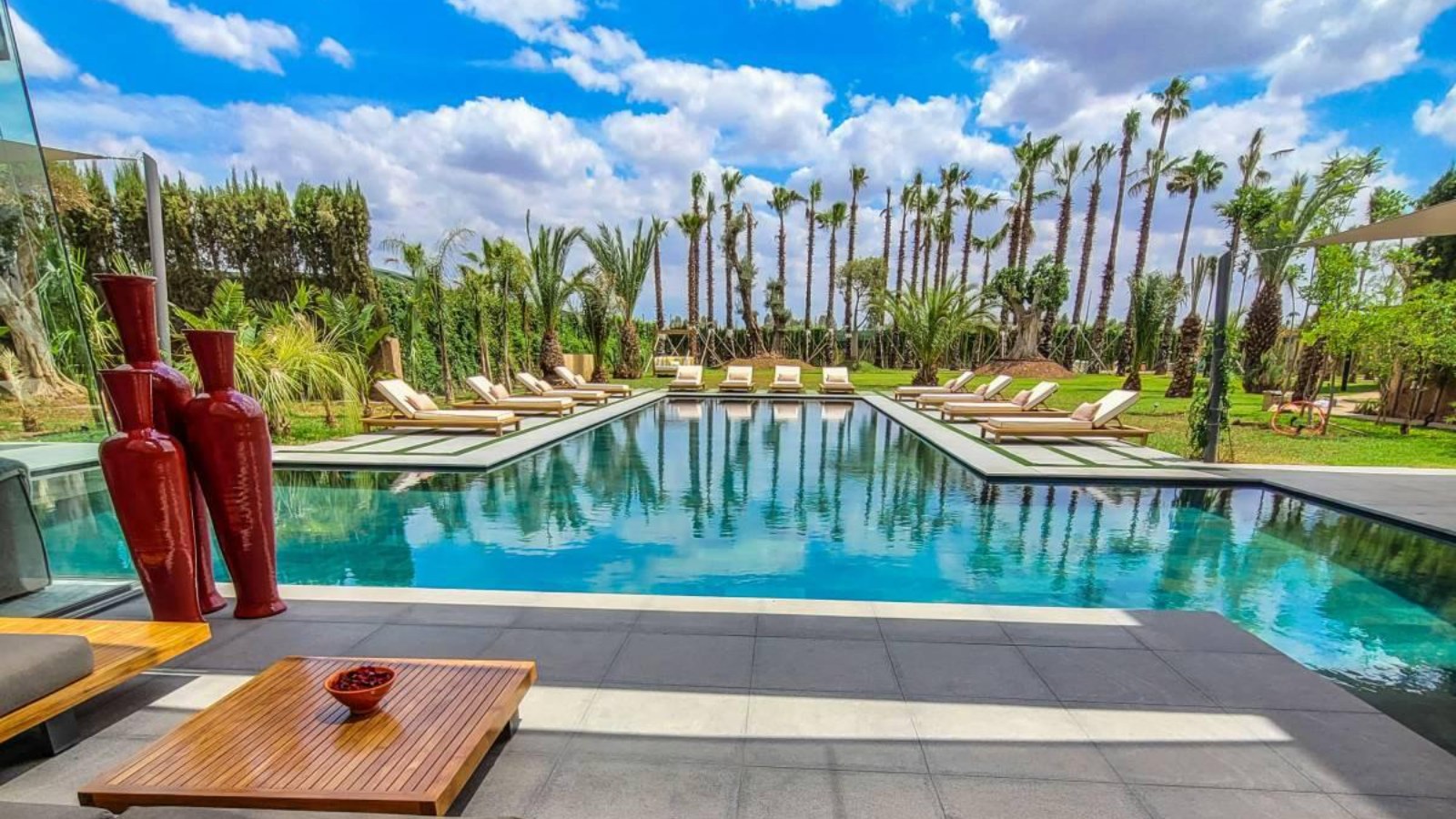
Marrakech has quietly become one of the most watched second-home markets around the Mediterranean. Foreign tourist arrivals in Morocco climbed from 12.9 million in 2019 to 19.8 million in 2025, according to the Moroccan Ministry of Tourism figures cited by Knight Frank. Prime prices in the best estates have risen by an estimated 10 to 15 percent in two years, and a new wave of buyers, from French and Belgian families to Gulf-based professionals and the Moroccan diaspora in the United States, is competing for the same small pool of well-built homes.
That combination creates opportunity and risk in equal measure. A well-chosen villa can give you a winter home in the sun, a rental income and a long-term asset in a city whose infrastructure is being upgraded ahead of the 2030 FIFA World Cup. A poorly chosen one can trap you with an unclear title, a water problem or a price you will never recover.
This guide is written for both kinds of reader: the investor who wants numbers and the family who wants a home. It walks you through every stage of finding a villa for sale Marrakech buyers actually want to own, from choosing the right neighbourhood to signing at the notary, with the mistakes we see most often and how to avoid them.
At a glance: the Marrakech villa market in 2026
- Prime residential values: roughly €5,500 to €7,000 per m², with the best villas higher (Knight Frank, 2026).
- Expected prime price growth in 2026: around 6 percent (Knight Frank forecast).
- Short-term rental gross yields: 7 to 10 percent are achievable for well-located, well-run villas (Knight Frank).
- Buying costs for an international buyer: around 10 percent of the price, all-in (Knight Frank).
Foundations: What You Are Really Buying in Marrakech
Before you look at a single listing, it helps to understand how the Marrakech market is organised. Property here is not one market but several, each with its own buyers, prices and rules.
The three main property types
Villas are detached houses on their own plot, usually with a private pool and garden. They range from compact three-bedroom homes in gated communities to estates of several hectares in the Palmeraie. They suit families, buyers who want privacy and outdoor space, and investors targeting high-end holiday rentals.
Riads are traditional houses built around an inner courtyard, mostly inside the old walled Medina. They offer charm, history and a strong rental story, but also narrow access, older structures and specific renovation rules. A riad for sale Marrakech is a different purchase from a villa, with different checks, and we cover it in a separate guide.
Apartments are concentrated in Guéliz, Hivernage, Avenue Mohammed VI and the golf resorts. They are easier to manage, cheaper to maintain and popular with buyers who spend only part of the year in the city or want a lock-up-and-leave base.
| Property type | Typical buyer | Strengths | Watch out for |
|---|---|---|---|
| Villa | Families, second-home owners, rental investors | Space, privacy, pool, strong high-end rental demand | Title, water supply, running costs, build quality |
| Riad | Heritage lovers, guesthouse projects | Character, central location, tourist appeal | Structure, damp, access, renovation permits |
| Apartment | Part-time residents, first-time investors | Lower entry price, easy upkeep, city services | Service charges, co-ownership rules, view and noise |
Where the villas are: the main neighbourhoods
Location decides more of a villa's value than its finishes. These are the areas most buyers compare.
- The Palmeraie. The historic address for luxury villas, with large plots among palm groves, about 15 minutes from the centre. It holds some of the city's most expensive homes and a deep pool of international buyers. Plot size and the quality of access roads vary enormously from one lane to the next.
- Hivernage. The most central upscale district, close to the Medina, hotels and restaurants. Villas are rarer and plots smaller, but the address commands some of the highest prices per square metre in the city.
- Route de l'Ourika and Route d'Amizmiz. Newer estates on larger plots with Atlas views, often more contemporary in design. Prices per square metre are lower than in the Palmeraie, which attracts buyers looking for space and value.
- The golf areas. Amelkis, Royal Palm, Al Maaden and other golf communities offer gated security, managed common areas and a ready-made lifestyle. Knight Frank identifies Royal Palm and Amelkis among the areas where prime prices have risen fastest.
- Targa and Guéliz outskirts. Residential districts with family villas closer to everyday services and international schools.
For a deeper comparison, read our guide to the best neighbourhoods to buy property in Marrakech.
Market principles every buyer should understand
Land is the real asset. In the outer districts, a villa's value is driven first by the plot: its size, shape, title status and access. Buildings age; a good plot with a clean title keeps its value.
It is a two-speed market. Knight Frank describes a gap between a small number of well-built, turnkey homes and a larger stock of uneven quality. The best homes sell quickly and hold their price; average ones can sit on the market for a long time.
Asking prices are not market prices. Listings in Marrakech often start well above what properties eventually sell for. A good adviser will tell you what similar homes have actually sold for, not just what sellers hope to get.
Foreigners can buy freely, with one main exception. Non-Moroccans can own residential property in their own name. Agricultural land outside urban zones is the main restriction, which matters for some large plots on the edge of the city. Our article on buying property in Morocco as a foreigner explains the rules in detail.
Current Trends and Key Statistics
Good decisions start with accurate numbers. Here is what the most recent data says about the market you are entering.
Prices: where the market stands in 2026
Knight Frank's 2026 Marrakesh report places prime residential values at roughly €5,500 to €7,000 per square metre, with a central estimate of about €6,000 and the very best villas above that range. That is still a fraction of prime prices in other lifestyle cities: the same report cites about €10,200 per m² in Marbella, €10,730 in Lisbon and €23,000 in Paris.
Prices vary widely by district. The ranges below come from ReaConsult's 2026 reference values for villas, expressed in dirhams per square metre. They are indicative ranges, not guaranteed sale prices, and exceptional properties sit outside them.
| District | Villa reference range (MAD per m²) | What drives the price |
|---|---|---|
| Palmeraie | 18,000 – 35,000 | Plot size, privacy, prestige, rental demand |
| Hivernage | 18,000 – 28,000 | Central location and scarcity |
| Guéliz | 14,000 – 22,000 | Urban services, schools, walkability |
| Avenue Mohammed VI | 14,000 – 20,000 | Modern infrastructure, access |
| Targa / Route de l'Ourika | 9,000 – 15,000 | Larger plots, views, newer builds |
Source: ReaConsult, Marrakech property prices 2026 by district (April 2026). Figures are reference ranges.
Price momentum: strong at the top, calmer elsewhere
The market is moving at two speeds. In the prime segment, Knight Frank estimates growth of 10 to 15 percent over the past two years in Royal Palm, Amelkis, the Palmeraie and selected Medina properties, and forecasts around 6 percent more in 2026. Across all segments, official data cited in the same report shows transactions up 12 percent in 2024.
The broader market is steadier. Bank Al-Maghrib's property price index for the second quarter of 2026 shows villa prices in Marrakech down 1.3 percent on the previous quarter, while the number of villa transactions in the city rose 13.6 percent. Nationally, villa prices were almost flat year on year (down 0.3 percent).
What this means for you: exceptional villas in the best estates are rising and rarely discounted. Ordinary villas, especially those with dated finishes or title questions, leave room to negotiate. Know which kind you are looking at before you make an offer.
Demand: who is buying, and why
Knight Frank's research describes a broader buyer base than a decade ago:
- European buyers, especially French, Belgian and British, remain the core of the market.
- The Moroccan diaspora, including professionals based in the United States, is increasingly active.
- Middle Eastern buyers, including families based in Dubai, are looking for an alternative lifestyle destination.
- Younger families and professionals in their 40s and 50s are buying for relocation or as second homes, while retirees are still present but no longer dominate.
One habit stands out: many wealthy buyers now rent for six to twelve months before buying. They test the neighbourhood, the seasons and the lifestyle, then purchase with far more confidence. If you have the time, it is one of the best ways to avoid an expensive mistake.
Rental demand: the tourism engine
Marrakech remains Morocco's leading tourist destination. In the first half of 2025, the city recorded about 5.06 million overnight stays in classified accommodation, up 6 percent on the year before, with an occupancy rate of 71 percent, according to the Moroccan Tourism Observatory as reported by North Africa Post. Nationally, 19.8 million foreign tourists visited in 2025.
For owners, that translates into real rental potential. Knight Frank puts achievable gross yields on short-term rentals at 7 to 10 percent, particularly for winter-sun stays. That is why a well-run vacation rental Marrakech villa can cover its own running costs and more, provided it is legally declared and professionally managed.
Turning your home into a vacation rental Marrakech guests book again
If you plan to rent your villa when you are not using it, set it up as a rental from the first day rather than adapting it later. Guests booking a villa in Marrakech usually travel as families or groups of friends, so they look for en-suite bedrooms, a heated or shaded pool, outdoor dining, reliable Wi-Fi and easy airport access.
Get the legal side right first. Complete the authorisation required under Law 80-14, take out the mandatory insurance and set up the daily guest declaration. Declare your rental income to the tax administration. Owners who skip these steps risk fines and lose the protection of a legal business.
Price by season. Demand in Marrakech peaks in the cooler months, around school holidays and major events, and softens in the hottest part of summer. A good manager adjusts nightly rates through the year instead of keeping one price.
Choose management carefully. Unless you live in the city, you will need a local team for check-ins, cleaning, laundry, maintenance and guest messages. Ask any manager for their fees, a sample monthly owner report and references from other owners.
How to estimate your net return (illustrative method)
Start with expected nightly rates multiplied by realistic booked nights. Subtract platform commissions, management fees, cleaning and laundry, utilities, maintenance, insurance and local taxes, then income tax. Divide what is left by your total purchase cost, including buying fees and furniture. A gross yield of 7 to 10 percent, the range Knight Frank considers achievable, will be noticeably lower once these costs are taken out, so always plan on the net figure.
High-potential areas to watch
- Route de l'Ourika and Route d'Amizmiz: more space for the money, newer homes and Atlas views, with buyers moving out from the Palmeraie.
- Golf communities: Royal Palm and Amelkis are among the prime areas with the strongest recent price pressure, helped by security and managed services.
- Well-located Palmeraie plots: the best lanes, with good access and clean titles, remain the benchmark for long-term value.
Practical Guide: How to Buy a Villa in Marrakech, Step by Step
The buying process in Morocco is secure when it is done properly, but it has its own steps and vocabulary. Here is the full journey, in order.
Step 1: Define your project and budget
Start with three questions. Will you live in the villa, rent it, or both? How many months a year will you spend in Marrakech? What total budget, including costs, can you commit without strain?
Your answers decide almost everything else. A family home needs schools and services within reach. A rental investment needs a location guests will pay for and a layout that suits groups. A part-time home needs security and someone to look after it when you are away.
Remember that the price on the listing is not your budget. Knight Frank estimates total transaction costs for international buyers at around 10 percent of the price. Build that in from day one.
Step 2: Choose the right adviser
The single most important decision you will make is who helps you buy. A reputable Marrakech real estate agency will know which homes are genuinely available, what they have sold for, which titles are clean and which sellers are realistic. It will also have access to properties that never appear online. Our guide to off-market real estate in Marrakech explains how that part of the market works.
Alongside the agent, you will need a notary. In Morocco, the notary drafts the deed, checks the title, collects taxes and registers the sale. Choose your own notary rather than accepting whoever the seller suggests.
Step 3: Search, visit and shortlist
Visit at different times of day. A lane that is calm at noon can be busy at night, and a garden that looks perfect in winter may be in full sun in July. Check the drive time to the places you will use most: the airport, the Medina, schools, golf courses and supermarkets.
For each villa on your shortlist, note the plot size, built area, number of bedrooms with bathrooms, pool size, orientation, the age of the build and any recent renovation. These details will matter when you compare prices.
Step 4: Check the legal status of the property
This is the step that protects your money. In Marrakech you will meet three main situations:
| Status | What it means | Our advice |
|---|---|---|
| Titre foncier (registered title) | The property is registered with the Land Registry (ANCFCC), with defined boundaries and a record of owners and charges. | The safest option. Ask for a recent certificate showing owners, mortgages and other charges. |
| Réquisition | A registration has been requested but is not complete. | Possible, but get a notary's view on how far the process has gone and any objections. |
| Melkia | Traditional ownership proved by witness deeds, not registered. | Higher risk for foreign buyers. Proceed only with specialist legal advice, ideally after registration. |
Also check that the building matches the title and permits. Extensions, pool houses and extra floors are sometimes added without authorisation. Ask for the building permit and the certificate of completion, and compare the built area on paper with what you see. Our article on checking titled land in Marrakech goes deeper.
Step 5: Inspect the villa properly
A beautiful finish can hide expensive problems. Before you commit, have the villa inspected, ideally by an independent architect or engineer. Focus on:
- Water: mains connection, well, borehole or storage tanks. Water supply is one of the most important questions in Marrakech, especially for villas with large gardens and pools.
- Structure: cracks, damp, roof waterproofing and the quality of terraces.
- Pool: leaks, filtration equipment, heating and the condition of the surrounding deck.
- Electricity and insulation: capacity for air conditioning, quality of windows and protection from summer heat.
- Running costs: garden and pool maintenance, security, staff and local taxes.
For a structured approach to price, see how we value a luxury villa in the Palmeraie.
Step 6: Negotiate and agree the terms
Base your offer on comparable sales, the condition of the villa and the time it has been on the market. Agree in writing on what is included: furniture, equipment, fittings, and who pays which costs. If the villa is being sold furnished, ask for an inventory.
Agree on a timeline that leaves room for legal checks and, if you need one, a mortgage approval.
Step 7: Sign the preliminary contract
Once terms are agreed, buyer and seller usually sign a preliminary contract (promesse de vente or compromis) and the buyer pays a deposit, commonly held by the notary. The contract sets the price, the completion date and the conditions, such as clear title or financing.
New rule since July 2026
Law 41.25, published in the Official Bulletin on 16 July 2026, requires transfers of property, promises of sale, special powers of attorney for these operations and off-plan preliminary contracts to be made by authentic deed. A deed that does not meet this form can be declared void. In practice: sign your preliminary contract and any power of attorney with a notary, not on a simple private agreement.
Step 8: Transfer the funds the right way
If you are a non-resident, bring the money into Morocco through a bank as foreign currency and keep every bank certificate. This is what allows you to transfer your capital, and your capital gain, back out of the country when you sell. Read how to repatriate your money after selling in Morocco before you transfer anything.
Note also that the 2026 Finance Law adds a 2 percent registration duty where a price above 300,000 MAD is paid in a way that cannot be traced. Pay through the banking system and make sure the payment method appears in the deed.
Step 9: Financing your villa
Many buyers pay cash, but Moroccan banks do lend to non-residents, usually for part of the price and with a personal contribution. You can also borrow in your home country against other assets. Compare the total cost, the currency risk and the time needed for approval. Our guide on mortgages for non-residents in Morocco gives the details.
Step 10: Completion and registration
On completion, the final deed is signed before the notary, the balance is paid and the notary registers the sale with the tax administration and the Land Registry. Expect these main costs:
| Cost | Rate | Notes |
|---|---|---|
| Registration duty | 4% (built property) | 5% for vacant land |
| Land Registry fee | 1.5% + 100 MAD | Paid to the ANCFCC |
| Notary fees | Set by the notary's scale | Plus VAT; ask for a written estimate |
| Agency commission | Set in the agency contract | Check who pays it before you visit |
| Bank and mortgage costs | Varies | Only if you borrow |
For a full breakdown, see notary and registration fees when buying in Morocco.
Step 11: Plan your running costs before you buy
The purchase price is only the start. A villa has ongoing costs that you should know before you commit, because they affect both your comfort and your rental return. Ask the seller for the bills of the last twelve months and check them against the list below.
| Cost | What it covers | How to keep it under control |
|---|---|---|
| Local taxes | Municipal and housing taxes based on the property's rental value | Knight Frank estimates around €3,000 a year for a prime villa; ask your notary for the exact amount |
| Garden and pool | Gardener, pool technician, chemicals, equipment repairs | Drought-tolerant planting and a pool cover reduce both water and labour |
| Water and electricity | Mains water, borehole pumping, air conditioning, pool heating | Solar water heating, good insulation and efficient air conditioning |
| Security and staff | Guardian, housekeeper, gated community charges | Gated estates share these costs across many homes |
| Insurance and maintenance | Building and contents cover, repainting, waterproofing | Budget a yearly maintenance fund rather than waiting for repairs |
A simple rule: a villa that is cheap to buy but expensive to run is rarely a bargain. Two homes at the same price can have very different annual costs depending on plot size, pool size and how well they are built.
How to spot the right villa for sale Marrakech listings
- Rent before you buy if you can, even for a month in each season.
- Prioritise the plot and the title over the interior. You can change a kitchen; you cannot change a lane or a legal problem.
- Look for homes that suit both living and renting: en-suite bedrooms, a self-contained guest area, a pool with shade and good parking.
- Ask for the running costs of the last twelve months before you make an offer.
- Be ready to move quickly on a genuinely good property. The best homes in the prime segment rarely stay available for long.
Pitfalls to Avoid and Best Practices
Most problems we see are avoidable. Here are the mistakes that cost buyers the most, and how to protect yourself.
Mistake 1: Paying a deposit before checking the title
Never pay money to a seller or intermediary before a notary has checked the title certificate. Ask for an up-to-date certificate and make sure the seller is the registered owner, or has a valid power of attorney signed in the correct legal form.
Mistake 2: Signing a private agreement
Since Law 41.25 came into force in July 2026, a promise of sale or transfer that is not an authentic deed can be declared void. Use a notary for every binding document.
Mistake 3: Under-declaring the price
Some sellers suggest declaring a lower price to reduce taxes. Refuse. You lose the ability to repatriate the undeclared amount, you increase your future capital gains tax, and you expose yourself to penalties. In Morocco, capital gains tax on property is 20 percent of the gain, with a minimum of 3 percent of the sale price, as Knight Frank notes. A low declared price today means a higher tax bill when you sell. Read more in our guide to capital gains tax in Morocco.
Mistake 4: Ignoring water and running costs
A large garden and pool can cost a lot to run, and water is a real constraint in the region. Ask how the villa is supplied, what the bills were last year and what the garden needs. Drought-tolerant landscaping can save money and add value.
Mistake 5: Buying for rental without checking the rules
Short-term rental in Morocco falls under Law 80-14 on tourist accommodation and its implementing decree of July 2023. According to the Ministry of Justice, as reported by Hespress in December 2025, this involves an administrative authorisation, mandatory insurance, safety standards and the daily declaration of guests to the authorities. Rental income must also be declared for tax. Build these steps and costs into your plan from the start.
Mistake 6: Overpaying for finishes
Expensive marble and designer kitchens add less value than sellers think. Compare price per square metre of land and building, not just photos. A well-built villa with simple finishes on a great plot is usually the better investment.
Best practices that protect you
- Use your own notary and, for complex purchases, an independent lawyer.
- Keep every bank transfer record and currency certificate.
- Get the inspection done before you sign the preliminary contract.
- Write conditions into the contract: clear title, matching permits, financing if needed.
- Ask your agent for recent comparable sales, not just asking prices.
Case Studies: How Smart Buyers Approach a Marrakech Villa
The scenarios below are illustrative examples based on situations we commonly see. They are not testimonials from named clients, and the figures are rounded for clarity.
Case 1: The family that rented first
A family relocating from Europe rented a villa in Targa for nine months before buying. During that time they realised that the school run from the Palmeraie would take too long each day, and that they valued being close to Guéliz. They bought a four-bedroom villa in a gated community near Targa instead of the larger Palmeraie home they had first imagined. The result: a lower price, lower running costs and a daily life that works.
Lesson: renting first, as many high-net-worth buyers now do, turns assumptions into facts.
Case 2: The investor who bought on the plot, not the finish
An investor compared two villas at similar prices: one newly renovated on a small plot, one dated but on a large titled plot in a sought-after Palmeraie lane. She chose the second, renovated it in stages and set it up as a declared holiday rental. Because the plot and location were strong, the renovation added value rather than just cost.
Lesson: in the outer districts, land and location drive long-term value.
Case 3: The buyer who walked away
A couple fell in love with a villa on the Route d'Amizmiz. The inspection found that a pool house and a first-floor extension did not appear in the permits, and the title was still a réquisition. Instead of signing, they asked the seller to regularise the situation first. The seller could not do so within their timeline, so they bought elsewhere.
Lesson: the best deal is sometimes the one you do not sign. A good adviser will tell you when to walk away.
The Next Wave: Where the Market Is Heading
Several forces will shape the next five years in Marrakech.
World Cup 2030 and infrastructure
Morocco is co-hosting the 2030 FIFA World Cup, and the projects linked to it are speeding up. Knight Frank highlights two that matter for Marrakech buyers: the planned high-speed rail extension between Casablanca and Marrakech, which should cut the journey to around 90 minutes, and the expansion of Marrakech Menara Airport to double its capacity to 16 million passengers. The airport already serves 111 destinations, including New York and Riyadh. Easier access widens the pool of buyers and renters.
A more professional, more regulated market
The legal framework is tightening. Law 41.25 now requires authentic deeds for property transfers, and short-term rentals are being brought more firmly under Law 80-14. A long-awaited law to regulate the profession of real estate agent has been under discussion for years. For buyers, all of this means more security, but also less room for informal shortcuts.
Emerging areas and buyer trends
- The routes out of the city, Ourika and Amizmiz in particular, should keep attracting buyers looking for land, views and contemporary design.
- Turnkey homes will stay in short supply. Knight Frank notes that most listings are furnished resale villas and that high-quality new stock is limited, which supports values for the best homes.
- Younger and more international buyers, including US and Gulf-based buyers, will push demand for modern layouts, energy efficiency and good connectivity.
- Sustainability, especially water management and heat protection, will increasingly separate desirable homes from the rest.
For investors weighing the timing, our article on price per square metre in Marrakech by area helps you compare districts.
Is now the right time for real estate investment Marrakech?
Nobody can time a market perfectly, but the current picture is clear enough to act on. Prime values are forecast to keep rising, supported by international demand and new infrastructure. At the same time, Bank Al-Maghrib's data shows that the wider villa market is broadly stable, which gives buyers room to negotiate on average properties.
For most buyers, the better question is not "when" but "what". A well-located villa with a clean title, sound construction and controlled running costs is a sound purchase in most market conditions. A weak property bought at the top of an enthusiastic cycle is not. Focus on quality, buy for the long term and treat any rental income as a bonus that improves your return rather than the only reason to buy.
Where luxury fits in
At the very top, the market behaves differently. A luxury property Marrakech buyers compete for, on a large titled plot in the Palmeraie or a golf estate, is driven less by local economics and more by international wealth and lifestyle choices. These homes are scarce, and when they are well priced they sell fast. For many buyers, this segment is both a home and a store of value, and a sensible part of a wider real estate investment Marrakech strategy.
Your Practical Checklist for Buying a Villa in Marrakech
Use this checklist from your first visit to the day you collect the keys.
Before you search
- Define your use: home, rental or both.
- Set a total budget that includes around 10 percent for costs.
- Decide on two or three target neighbourhoods.
- Consider renting for a few months first.
- Choose an experienced agent and your own notary.
Before you make an offer
- Visit at different times of day and in different seasons if possible.
- Ask for recent comparable sales.
- Request the title certificate, permits and certificate of completion.
- Check water supply, running costs and local taxes.
- Commission an independent inspection.
Before you sign
- Sign the preliminary contract and any power of attorney before a notary.
- Include conditions for title, permits and financing.
- Transfer funds through a bank and keep every certificate.
- Agree an inventory if the villa is sold furnished.
After completion
- Get a copy of the registered title in your name.
- Insure the property and set up maintenance.
- If you plan to rent, complete the authorisation and tax steps before the first booking.
Frequently Asked Questions
Can a foreigner buy a villa in Marrakech?
Yes. Foreigners can buy residential property in their own name. The main restriction concerns agricultural land outside urban areas. Your notary will confirm the status of the specific plot.
How much does a villa cost in Marrakech?
It depends heavily on the district and the plot. Knight Frank puts prime residential values at around €5,500 to €7,000 per m², and ReaConsult's 2026 reference ranges for villas run from about 9,000 MAD per m² on the Route de l'Ourika to 35,000 MAD per m² at the top of the Palmeraie.
What are the total buying costs?
Plan for around 10 percent of the price for an international buyer. This includes the 4 percent registration duty, the 1.5 percent Land Registry fee, notary fees with VAT, and any agency and bank costs.
Can I rent my villa to tourists?
Yes, within the legal framework. Short-term rental is governed by Law 80-14 and its 2023 decree, which require authorisation, insurance and the declaration of guests. Rental income is taxable in Morocco.
What rental yield can I expect?
Knight Frank considers gross yields of 7 to 10 percent achievable for well-located short-term rentals. Net returns depend on occupancy, management fees, maintenance and tax.
Do I get residency if I buy a villa?
Buying property does not automatically give you residency, but it can support an application. Read our guide to residence permits after buying in Morocco.
Can I get my money back out when I sell?
Yes, if you brought the funds in through a bank as foreign currency and kept the certificates. You can then repatriate the purchase price and the capital gain after tax.
How long does a purchase take?
For a titled villa with a cash buyer, a few weeks to a few months is typical. Mortgages, réquisition titles or missing permits add time.
Should I buy a villa or an apartment?
A villa offers space, privacy and stronger high-end rental demand. An apartment for sale Marrakech buyers choose is easier to manage and cheaper to run. If you will spend only a few weeks a year in the city, an apartment may suit you better.
How can Marrakech Sunset help?
We help buyers find the right villa for sale Marrakech offers, including off-market homes, check titles and permits with your notary, negotiate the price and organise rental management if you need it. Contact us to discuss your project, with no obligation.